Smart Air Purifiers 2026 — HEPA, CADR, and AHAM Standards Compared
How HEPA grade, AHAM CADR rating, and EPA's voluntary smart-feature spec affect actual room-coverage performance — covering Coway Airmega, Levoit, Blueair, and Dyson smart air purifiers.
The air purifier category is unusual in smart-home shopping because the underlying performance does not actually depend on the smart features. A purifier’s CADR rating — how fast it cleans a given room size — is determined by the motor, filter area, and airflow design. Smart connectivity adds auto-adjustment, app-based monitoring, and scheduling, but the core purification chemistry is the same as a non-smart model in the same physical hardware.
What this means in practice: a buyer who optimizes for smart features and ignores CADR ends up with a clever-looking purifier that cannot clean their room fast enough. The right pattern is to match CADR to room size first, verify HEPA grade and AHAM certification, then add smart features as a tiebreaker among models with adequate purification capacity.
- HEPA grading and how to identify true HEPA filters
- AHAM CADR rating and how to match it to your room
- What smart features actually add (and what is marketing fluff)
- Filter replacement economics over multi-year ownership
- Top picks by room size and ecosystem need
HEPA, True HEPA, and what to skip
The HEPA standard has been a magnet for marketing creativity. True HEPA filters meet a specific standard — capturing at least 99.97% of particles at the 0.3-micron size, the size hardest to capture (smaller particles get caught by diffusion, larger ones by interception or impaction). ISO 29463 further breaks True HEPA into grades H13 (99.95% at 0.3 micron) and H14 (99.995%).
Terms to treat skeptically:
- “HEPA-type” — not regulated; can mean significantly lower filtration
- “HEPA-like” — same concern
- “99% efficient” — incomplete claim; depends on particle size tested
- “Permanent HEPA filter” — often refers to a washable pre-filter, not the True HEPA layer
For most household uses (pollen, pet dander, wildfire smoke, household dust), True HEPA at the standard 99.97% is sufficient. H13 grade is a meaningful step up for households with severe allergies. H14 is overkill outside medical environments.
CADR — the number that actually matters

Clean Air Delivery Rate is the AHAM-standardized output measurement. Filters can technically capture 99.97% of particles, but if airflow is low, the room never reaches clean status. CADR measures the actual rate of clean air delivery in cubic feet per minute (CFM), separated by particle type:
- Smoke CADR — fine particles, similar in size to wildfire smoke and PM2.5
- Pollen CADR — medium particles
- Dust CADR — slightly larger particles
The Smoke CADR is usually the limiting number; if a purifier handles smoke well, it handles dust easily. AHAM’s room-sizing rule of thumb: minimum Smoke CADR = room area × 0.65. A 350 sq ft room needs a purifier with at least 230 Smoke CADR for 5 air changes per hour (the rate AHAM uses for general air quality).
The most common buyer mistake is undersizing — buying a purifier rated for 200 sq ft and using it in a 400 sq ft open-plan living room. The purifier runs continuously, the filter shortens, and the air never fully cleans. Better to oversize and run on a lower speed setting.
What smart features actually add
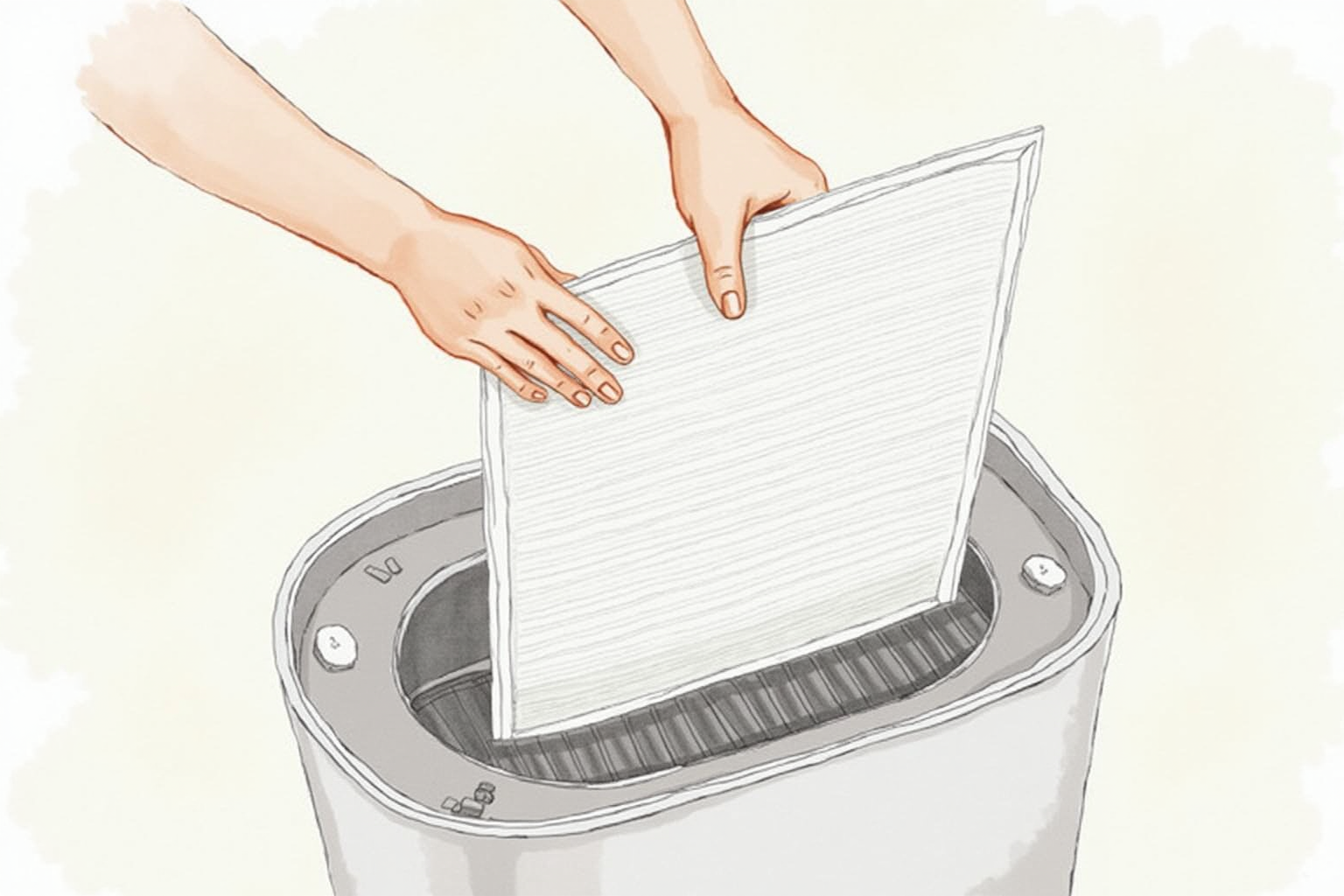
Auto-mode response is the practical smart feature. Smart purifiers include PM2.5 or PM10 sensors that read indoor particle levels every few seconds and adjust fan speed accordingly. The benefits compound:
- Quiet operation when air is already clean (sleep mode)
- Automatic response to cooking smoke or wildfire events
- Filter life tracking based on actual run hours, not calendar days
- App alerts when filter replacement is due
Marketing-only “smart” features to discount:
- Voice control — useful occasionally, but most purifier control happens via app or auto-mode
- HomeKit/Alexa/Google certification — nice-to-have, but auto-mode reduces the need for voice control
- Air quality history graphs — interesting once, rarely changes behavior
The auto-adjust feature is the only smart capability that materially improves day-to-day air quality. The rest is convenience.
Filter economics
Filter replacement is the recurring cost that determines true cost of ownership. Patterns:
- Coway Airmega 200M / Mighty — replacement filter set $40-60, typical 12-month interval
- Levoit Core 600S — replacement filter $50-70, typical 6-12 month interval
- Blueair Blue Pure 211+ — replacement filter $30-40, typical 6-month interval (smaller capacity)
- Dyson — replacement HEPA + carbon $80-120, typical 12-month interval
Over 5 years of typical use, filter costs equal or exceed the original purifier cost for most premium models. Mid-tier purifiers (Coway, Levoit) generally have lower filter costs than ultra-premium brands (Dyson, IQAir) for similar CADR ratings.
Avoid off-brand “compatible” replacement filters — independent testing has found significant variability in filtration efficiency, and the certification chain breaks. Buy OEM replacement filters or directly from the manufacturer.
Top picks by room size
Coway Airmega 200M (Wirecutter pick, 361 sq ft)
Price · $200-280 — best mainstream room purifier
+ Pros
- · True HEPA + activated carbon filter combination
- · AHAM-certified CADR sufficient for typical living rooms
- · Auto mode and sleep mode without smart-app dependency
− Cons
- · Not WiFi-connected — manual or remote control only
- · Smaller carbon filter than premium alternatives
Paid affiliate link. Price, availability, and ratings can change; verify details on the retailer page before buying.
Levoit Core 600S Smart True HEPA (635 sq ft)
Price · $300-380 — best smart pick for large rooms
+ Pros
- · Strong CADR rating for open-plan living rooms
- · Built-in PM2.5 sensor with auto-adjust
- · Alexa, Google Assistant, app control
− Cons
- · Larger physical footprint than 200M-class purifiers
- · Annual filter cost on the higher end
Paid affiliate link. Price, availability, and ratings can change; verify details on the retailer page before buying.
Blueair Blue Pure 211+ Auto
Price · $300-380 — premium quiet-operation pick
+ Pros
- · Distinctive low-noise operation at all speeds
- · Auto mode with PM2.5 sensor
- · Strong CADR for medium-to-large rooms
− Cons
- · More frequent filter replacement (typical 6-month interval)
- · Higher per-year filter cost than Coway
Paid affiliate link. Price, availability, and ratings can change; verify details on the retailer page before buying.
Buyer’s path by use case
For most households, the Coway Airmega 200M or 400S covers the primary living space at reasonable cost-per-year. The lack of WiFi connectivity is not a meaningful loss for daily use — the auto mode and sleep mode operate without app intervention.
For households where indoor air quality is a priority (severe allergies, asthma, post-wildfire ongoing remediation), the Levoit Core 600S or comparable large-room smart purifier offers higher CADR and smart sensor response. The premium pays back through actually achieving clean status faster.
For ultra-quiet operation (bedrooms, recording studios), Blueair’s design philosophy emphasizes quiet at the cost of filter replacement frequency. Worth the premium if noise is the primary objection to other purifiers.
The category that consistently disappoints: small “personal” air purifiers under $50. The CADR is usually too low to meaningfully clean even a small office. The marketing emphasizes the HEPA filter; the limitation is the airflow. Skip the under-$60 tier entirely.
Pair the air purifier with the smart thermostat and the rest of the climate-control stack, and the overall indoor air quality system becomes more responsive to real conditions than any single device can deliver alone.